Cloud workspaces for coding agentsPrivate alpha
Coding agents
that keep working.
While you’re away.
Your native coding harnesses, running in the cloud.
One workspace from the first prompt to the final diff.
Explore the deck ↓

Native harnesses. Real environments. Reviewable work.Bootstrapped in India
The problemThe work around the agent
The agent can code.
The workspace still needs you.
Delegating a task should not mean babysitting a laptop, rebuilding an environment, or piecing the result back together.
ExecutionWork is tied to your machine.
A local terminal is a fragile home for a long-running task.
ContextThe work is scattered.
Conversation, files, running apps and review live in separate places.
HandoffsSwitching agents means more glue.
Different harnesses need explicit briefs, shared files and clear boundaries.
Statefold makes the workspace the durable part—not your terminal session.
The productStart → work → review
A real workspace.
Not just a chat window.
Start in the browser or offload a local checkout. Come back to the conversation, files, terminal, preview and diff.
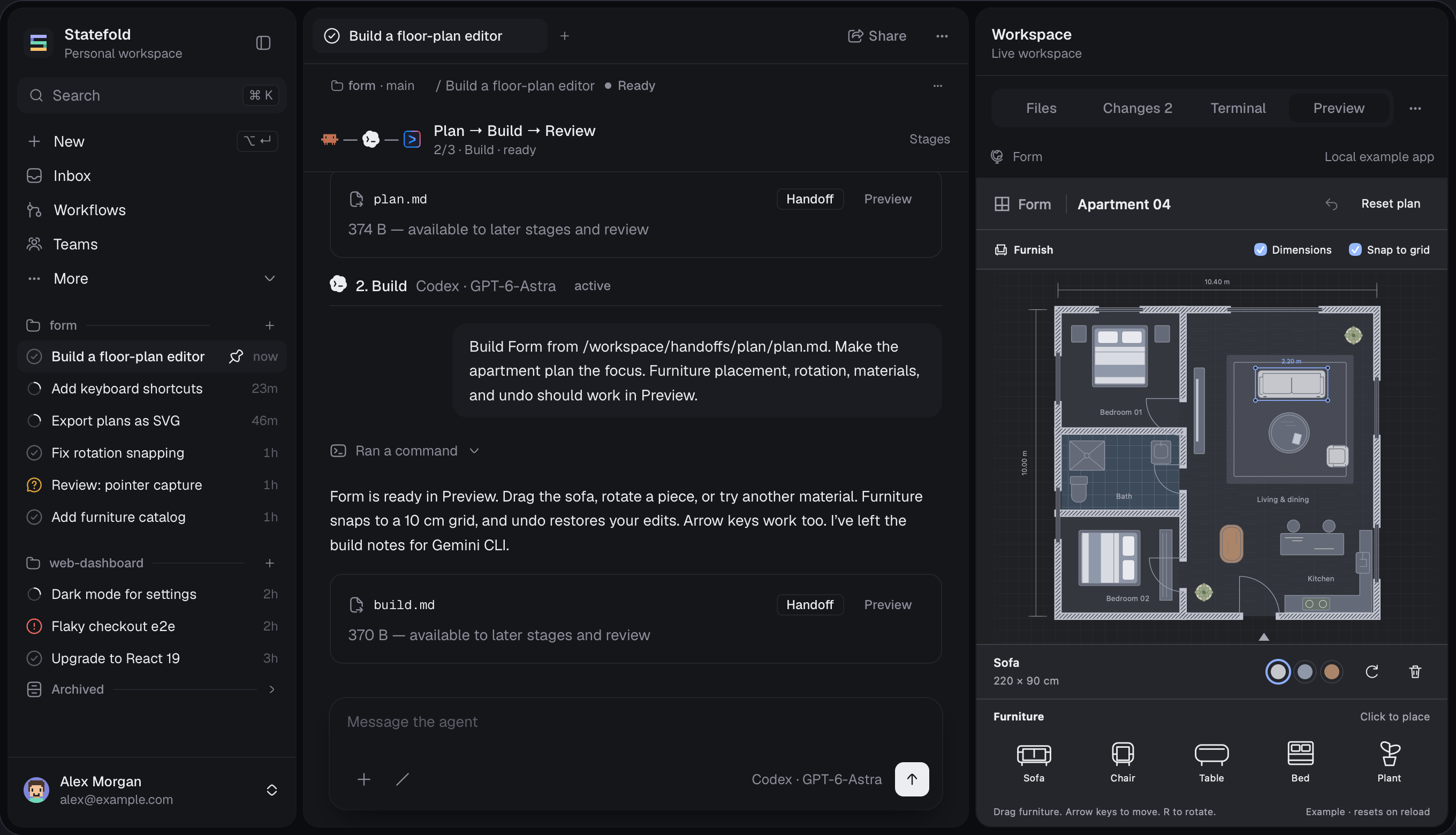 Actual Statefold interface with illustrative task content. Open the image to inspect the workspace.
How it worksNative conversations stay native
Different agents.
One body of work.
PlanClaude Code
Explore the repository. Write the brief.
plan.md
BuildCodex
Read the plan. Implement and test.
code + test results
ReviewOpenCode
Inspect the diff. Leave actionable feedback.
review.md
The harness owns the conversation.
Statefold owns the workspace.
Keep native tools, questions and permission requests. Connect your own providers instead of adopting a replacement agent.
Agents can delegate tasks and exchange briefs. Saved workflows order stages and use files for handoffs—not transferred conversation state.
Illustrative workflow. Harness support and authentication vary by provider. Codex and OpenCode lead the private-alpha rollout.
Who it is forBuilders with more work than time
Delegate the task.
Keep the judgment.
Our initial focus
Independent developers and small engineering teams already using coding agents.
Bug fixes, full-stack features, browser checks and review work that can run without holding a local machine open.
What makes Statefold different
Bring the harness you trust
Native agents and user-owned provider connections.
Keep the whole working environment
Conversation, filesystem, terminal, preview and changes together.
Let agents work across boundaries
Explicit delegation, file-based handoffs and human review.
The unit of value is a task you can review and ship, not another answer in a chat.
Business directionPrivate alpha → validated usage → paid workspaces
Charge for the workspace.
Let builders choose the model.
Planned revenueWorkspace subscription
Managed tasks, project context, collaboration and review.
+Planned usage componentMetered cloud compute
Execution resources for active tasks, with clear usage boundaries.
Users bring their own model-provider connections. We focus on the environment and the workflow around the harness.
Validate before scaling. Start with individual builders, learn from real task workloads, then expand into repeatable team workflows.
Proposed model, not current pricing. Commercial packaging and unit economics are still being validated.
Daytona evaluationProposed integration · CPU workloads
A stronger foundation
for autonomous work.
We’re evaluating Daytona as an execution backend for Statefold’s cloud workspaces.
Startup credits would fund integration testing and early reliability validation—not GPU training.
- Initial test profile
- 2 vCPU / 8 GiB RAM
- Workload
- Native coding harnesses,
full-stack apps, headless Chromium
What we need to prove
01A complete development environment
Package and browser downloads, running apps, authenticated terminals and private previews.
02Safe, recoverable execution
Credential isolation, process cancellation and filesystem preservation across sleep and restart.
03Economics that work at task scale
Measure startup latency, resource consumption and cost against our current execution backend.
Evaluation intent only. No Daytona integration, partnership, performance or savings claim is implied.
Founder & next stepBuilding from India
More work done.
Less work babysat.
Building the cloud workspace that lets native coding agents keep going—and brings the work back to you.
Visit statefold.sh ↗StagePrivate alpha
FundingBootstrapped
StartedAugust 2026
Next stepValidate the Daytona backend
statefold
 statefold